Retrofuturistic derivatives
As a wider variety of writers began to work with cyberpunk concepts, new sub-genres of science fiction emerged, playing off the cyberpunk label, and focusing on technology and its social effects in different ways. Many derivatives of cyberpunk are retro-futuristic, based either on the futuristic visions of past eras, or more recent extrapolations or exaggerations of the actual technology of those eras.
Steampunk
Steampunk, based on an era (c. 1820-1910) centered on the Victorian period, is one of the most notable developments of the cyberpunk concept. The genre initially combined extrapolations of Victorian technologies and styles with cyberpunk's bleak film noir world view. It has since developed in a less dystopian direction.
The word "steampunk" was invented in 1987 as a jocular reference to some of the novels of Tim Powers, James P. Blaylock, and K.W. Jeter. When Gibson and Sterling entered the subgenre with their collaborative novel The Difference Engine the term was being used earnestly as well. Alan Moore's and Kevin O'Neill's 1999 The League of Extraordinary Gentlemen comic book series (and the subsequent 2003 film adaption) popularized the steampunk genre and helped propel it into mainstream fiction.
The most immediate form of steampunk subculture is the community of fans surrounding the genre. Others move beyond this, attempting to adopt a "steampunk" aesthetic through fashion, home decor and even music. This movement may also be (perhaps more accurately) described as "Neo-Victorianism," which is the amalgamation of Victorian aesthetic principles with modern sensibilities and technologies. This characteristic is particularly evident in steampunk fashion which tends to synthesize punk, goth and rivet styles as filtered through the Victorian era. As an object style, however, steampunk adopts more distinct characteristics with various craftspersons modding modern-day devices into a pseudo-Victorian mechanical "steampunk" style. The goal of such redesigns is to employ appropriate materials (such as polished brass, iron, and wood) with design elements and craftsmanship consistent with the Victorian era.
Atompunk
Atompunk relates to the pre-digital period of 1945-1965, including mid-century Modernism, the Atomic Age and Space Age, Communism and concern about it exaggerated as paranoia in the USA along with Neo-Soviet styling, underground cinema, Googie architecture, the Sputnik programme, superhero fiction, the rise of the US military/industrial powers and the fall-out of Chernobyl. Its aesthetic tends toward Populuxe and Raygun Gothic, which describe a retro-futuristic vision of the world. The Fallout series of computer games is a prime example of this genre.
Clockpunk
Clockpunk is a subgenre of speculative fiction which is similar to steampunk, in that it portrays advanced technology based on pre-modern designs, but the technology used is based on springs and clockwork, and is usually set during the Renaissance, in the vein of Jay Lake's novel, Mainspring, and Whitechapel Gods by S M Peters. The term was coined by the GURPS role playing system.
Dieselpunk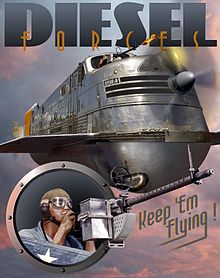
Dieselpunk is based on the aesthetics of the interbellum period through World War II (c. 1920-1945). This sub-genre is sometimes named Decopunk, referring to the Art Deco art style (including its Streamline Moderne variant). The genre combines the artistic and genre influences of the period (including pulp magazines, serial films, film noir, art deco, and wartime pinups) with postmodern technology and sensibilities. First coined in 2001 as a marketing term by game designer Lewis Pollak to describe his role-playing game Children of the Sun, dieselpunk has grown to describe a distinct style of visual art, music, motion pictures, fiction, and engineering. Examples include Crimson Skies, Sky Captain and the World of Tomorrow, Dark City, the BioShock series, and even Fisher-Price's Imaginext Sky Racers toy airplanes for children.
A 1986 William Gibson short story in the "Burning Chrome collection describes this genre as "The Gernsback Continuum", after the works of contemporary writer Hugo Gernsback.